
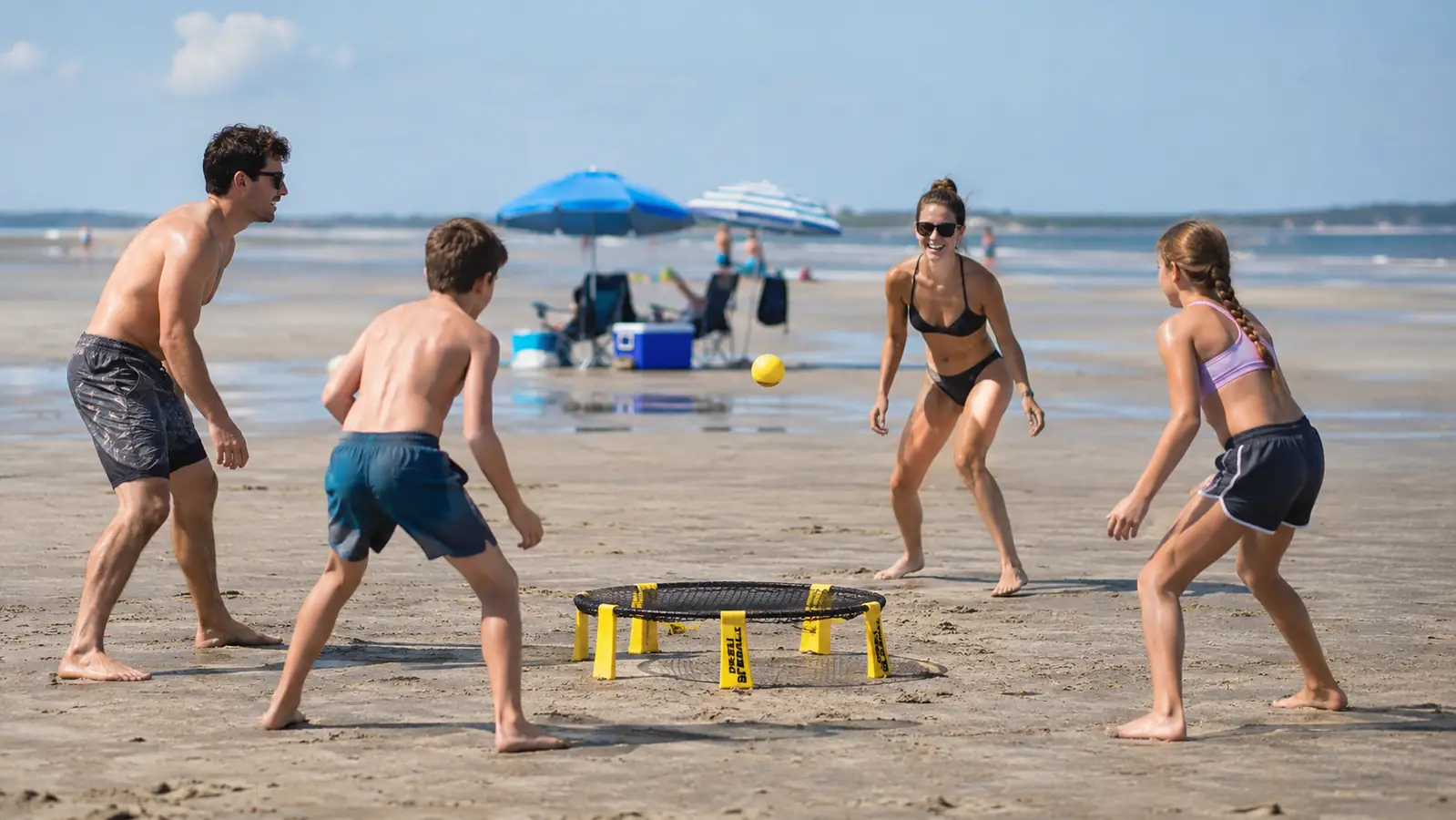
Every summer I watch the same thing happen on our stretch of the Jersey Shore. A family drags a volleyball net down to the water line, spends twenty minutes sinking poles into wet sand, and then spends the next hour chasing the ball into the surf because the sand shifted under the line. Roundnet is the game that fixes that. With a Spikeball set, the whole court is one small net that sits right on the sand, and it takes about two minutes to set up. I am Joan, and after three summers of playing this game with my husband Walt and the grandkids at our rented cottage, I can walk you through it start to finish.
The rules are simpler than they look, the gear holds up to sand and salt better than I expected, and there is almost no running, which matters to a 64-year-old with iffy knees. If you have never played roundnet before, this guide covers where to set up, how to assemble the Spikeball net, the basic serve and rally rules, and the sand-specific adjustments that keep the game from turning into a dig-fest.
The Spikeball set we take to the beach every single week
The 3 Ball Original Roundnet Set comes with the net, three balls, and a bag that shrugs off sand. It is the exact set we have played with for three summers, and it still sets up flat on packed sand in under two minutes.
Amazon Check Today's Price on Amazon →Step 1: Pick the Right Patch of Sand
The single biggest mistake I see is choosing the wrong spot. Roundnet does not need a big court like volleyball, but it does need a flat, firm surface. We look for the wide, flat sand near the water at low tide, the kind that is damp enough to hold a footprint but dry enough that you are not standing in a puddle. If the sand is too soft and powdery, the legs of the net sink unevenly and the ball dies when it hits. If it is too wet, you are playing in ankle-deep water by the second rally.
Here is how we check a spot before we even unpack the bag. I press the heel of my hand into the sand. If it leaves a clean impression without collapsing, the sand will hold the net legs. Then I walk a ten-foot circle around the spot and kick at any shells, seaweed, or driftwood. A stray shell under the net makes the frame rock, and a shell in the landing zone turns a good rally into a stubbed toe. Last July we set up in a stretch that looked perfect, and the first serve buried itself because the sand was softer than it looked. Walt re-anchored the legs twice before we moved twenty feet closer to the water, where the packed sand held firm all afternoon. The whole detour cost us maybe five minutes, but it saved the game, and now we always test the spot before we unpack anything.
One more tip: face the net so the sun is behind the players, not in their eyes. We learned that one the hard way on a July afternoon when every high serve disappeared into the glare. Since the net is round, you can aim it any direction, so take twenty seconds to rotate it before the first serve.
Step 2: Set Up the Spikeball Net So It Stays Put
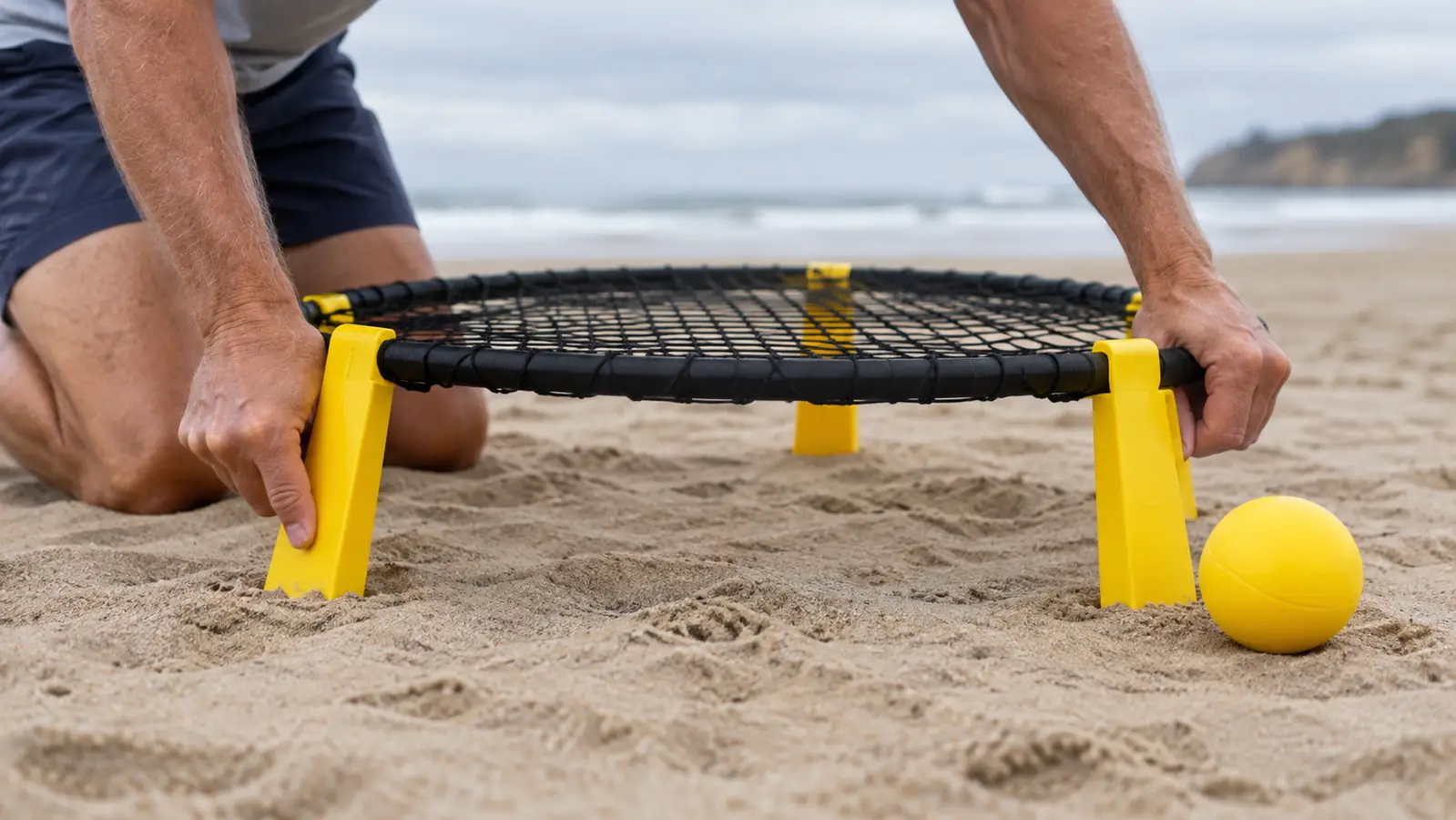
The Spikeball net assembles the same way on sand as it does on grass, with one important extra step. The three legs fold out, the net snaps onto the rim, and the whole thing sits about eight inches off the ground. On packed sand, that is usually enough. If the legs sink at all, we press them down until the rim is level, then mound a little sand over each foot. That anchor is the difference between a net that stays put for an hour and one that tilts after the first hard shot.
Tension is the thing most new players get wrong. The net should be tight enough that a ball dropped from chest height bounces up about waist height. If the net is loose, every hit dies and the rally ends in two touches. The Spikeball set uses a simple bungee system around the rim, so tightening it takes about thirty seconds. Give it a final tug before you serve, especially if the net has been sitting in the sun, because heat loosens the material. I check it the same way every time: I drop a ball from chest height, and if it comes back up past my waist, the net is ready. One August morning we skipped that check, and the first rally felt like hitting into a pillow. Thirty seconds with the bungee fixed it, and we have not skipped the check since, no matter how eager the kids are to start.
The bag matters more than you would think. The one that comes with the Spikeball set is the right size to hold the net, the three balls, and the legs without forcing anything. We keep the bag unzipped in the wagon during the day so the sand dries out instead of baking into the fabric, and the set has survived three full summers of that treatment.
Step 3: Learn the Serve and the Rally
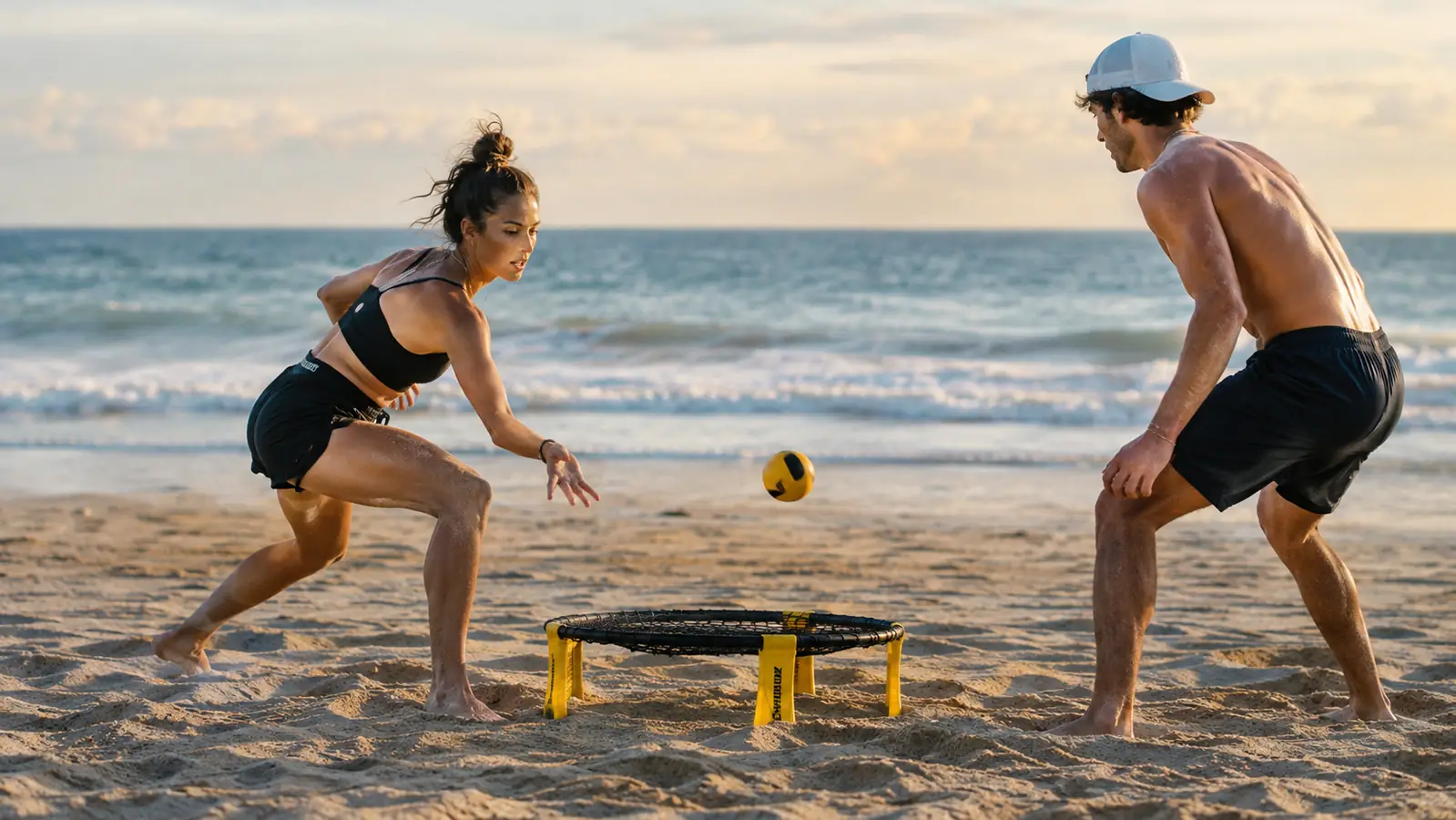
Roundnet is sometimes described as volleyball meets four-square, and that is a fair description. Two teams of two stand around the net, and the serving team hits the ball down onto the net so it bounces up toward the receiving team. The receiving team has up to three touches to control the ball and hit it back down onto the net. Then the original team takes up to three touches and returns it. The rally continues until the ball hits the ground, fails to reach the net, or goes out of bounds.
The serve is the part that trips up beginners. The server stands about six feet from the net, and the receiver stands directly across from them. The serve must be a downward hit that lands on the net and pops up, not a hard line drive that skims off the rim. On sand, we aim for a soft, high-arcing serve that drops almost straight down onto the net. That gives the receiver time to move, and moving in sand is slower than it looks.
The rally itself is forgiving. You can use your hands, wrists, or forearms, and you can hit the ball with an open palm, a fist, or a bump. The only real rules are that a player cannot hit the ball twice in a row, and the ball cannot touch the rim. When the grandkids play, we drop the three-touch limit and just let them swat it back and forth. The game is still fun, and they learn the rhythm of the bounce before they learn the fine points.
Step 4: Adjust for Sand, Wind, and Salt
Sand changes the game in three ways, and once you know them, you stop getting frustrated. First, the ball does not bounce off sand the way it bounces off grass or a gym floor. On a soft spot, the ball dies after one bounce, so we move the whole game to the firmer strip near the water at low tide. Second, every dive and slide kicks up sand, so the ball picks up grit. We brush the ball off with a hand before every serve, and we keep a spare ball in the bag because a sandy ball is a slippery ball. I timed it one afternoon just out of curiosity: a clean bounce off the packed strip near the water came up to my knee, while the same drop in the dry zone barely reached my ankle. That two-foot difference is the whole reason we pick the court location before we pick the teams. It also explains why the first game of the day is always the best one, before the tide shifts the playing surface.
Wind is the third adjustment, and it is the one that surprises people. The Spikeball balls are light, so a steady beach breeze can push a high serve a foot or two off course. The fix is simple: hit flatter serves on windy days, and position the net so the wind blows across the court instead of straight down the middle. We also tighten the net a little more on breezy days, because a loose net catches the wind like a sail and the whole frame can tip.
Salt and sun will age any beach gear, but the Spikeball set has held up better than I expected. The frame is aluminum, the net is a synthetic mesh, and the balls are solid rubber. We rinse the frame with fresh water from the outdoor shower at the cottage at the end of each week, and we never leave the set baking in direct sun all day. That routine has kept our set looking and playing like new through three summers.
Step 5: Keep the Game Fun for Mixed Ages
The best part of roundnet on sand is that it scales to whoever is playing. When it is just Walt and me, we play a relaxed two-on-two game with the regular rules, and because the court is only a ten-foot circle, my knees never complain. When the grandkids are here, we switch to the house rules that make the game go faster: every player gets two touches max, the serve can come from anywhere inside the circle, and a ball that bounces off the rim is replayed instead of ending the point.
We also rotate teams every few rallies so nobody gets stuck on the windy side or the sunny side. The kids love the rhythm of it, and the adults love that we are all moving without anyone running a mile. On the hottest afternoons, we play shorter games and use the ball bag as the boundary marker, which keeps the court honest without needing lines in the sand.
If you have a player who is brand new, let them start as the receiver on the softest serves. They get to feel the bounce of the ball before they have to make a hard return. Within one afternoon, the grandkids went from whiffing on every serve to running actual rallies, and that is the moment the game clicks for most people. The first real rally of the summer lasted seven hits, and the whole family stopped to watch. By the second week, the kids were calling their own fouls and arguing about who got the better side of the net, which is how I know a game has made it. We ended that week with a family tournament, four teams of two, and the trophy was just the leftover watermelon from lunch.
What Else Helps
A few small additions make beach roundnet a lot more comfortable. A cheap hand towel in the beach bag keeps the balls dry and grit-free between rallies. A small level is overkill; your hand is a good enough judge of whether the net is sitting flat. And if you are playing on a crowded beach, stake out your ten-foot circle early in the day, because the game attracts a crowd and you will want the room. One more thing: bring a spare ball if you have one. The Spikeball set includes three, which is enough for a full afternoon, but a ball can roll into the surf faster than you expect.
Three summers in, our original Spikeball set still sets up flat on packed sand in under two minutes, and that is the whole reason it is the game we actually play at the beach.
Set up your own beach court in two minutes
The Spikeball 3 Ball Original Roundnet Set has everything you need to start playing today: the net, three balls, and a carry bag built for sandy trips. It is the set we have used all summer, every summer, and it is still going strong.
Amazon Check Today's Price on Amazon →