
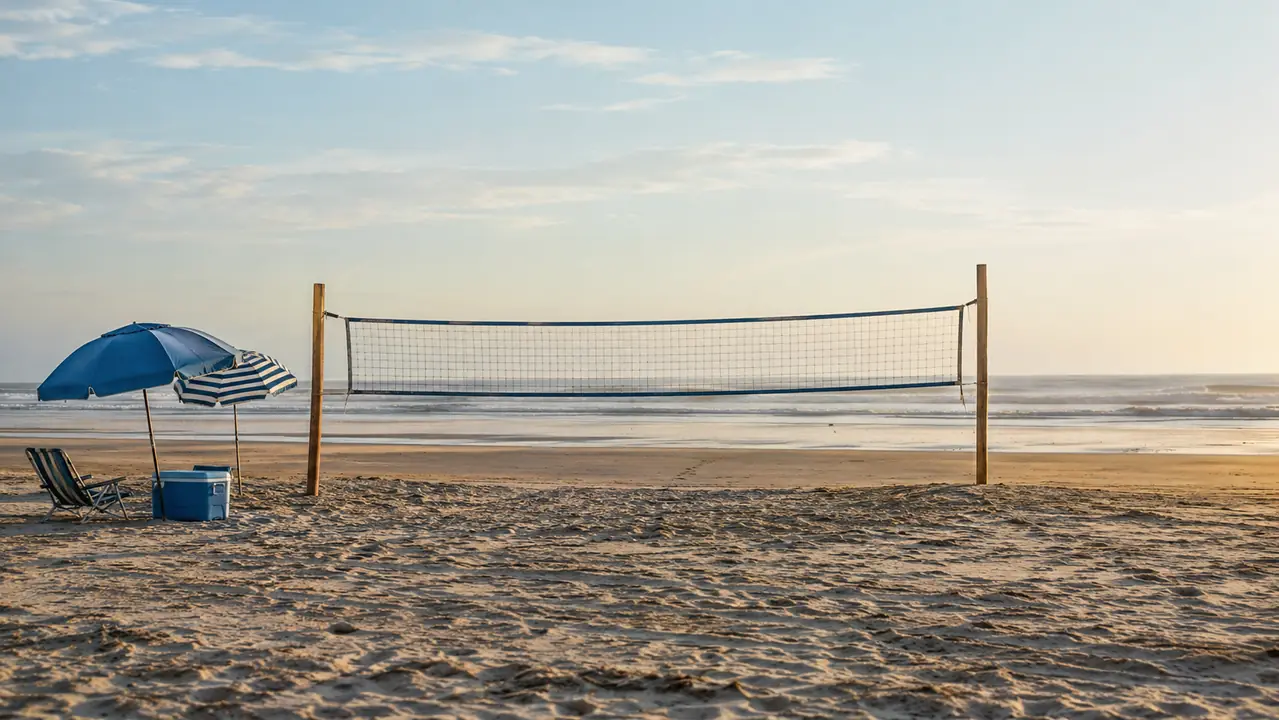
I'm Joan Whitaker, and I spend every summer at a rented cottage on the Jersey Shore with my husband Walt. By the second week of July, the grandkids are with us, the wagon is loaded with two umbrellas and a cooler, and someone always asks the same question: did you bring a volleyball net? Last summer I finally bought the Zdgao Portable Volleyball Net, the one with 1,185 reviews and a 4.6 star rating. I want to tell you what it is actually like to live with, because the listing photos do not show you the parts that matter.
The Quick Verdict
A solid, affordable net for casual family play on flat sand, but the poles flex in wind and the carrying bag rips faster than it should. Buy it for what it is, not for tournament-level tension.
Amazon Check Today's Price →The beach net that survived a month of grandkids, salt air, and afternoon wind
I bought the Zdgao for the summer and it held up better than I expected, with a few honest caveats. If you want a net that goes up in ten minutes and does not cost a fortune, this is the one I would pick again.
Amazon Check Today's Price on Amazon →How I've Used It
I set this net up on 22 separate days between July 1 and July 31. Most days were at low tide on the wide, flat sand near the water, which is the only surface where this net behaves. I used it with my husband, with the grandkids, and once with a group of six adults who played a genuinely competitive game for about an hour. Two of those adults had played high school volleyball, and they hit the ball hard enough that I held my breath the first few times it came down on the top edge. The net held.
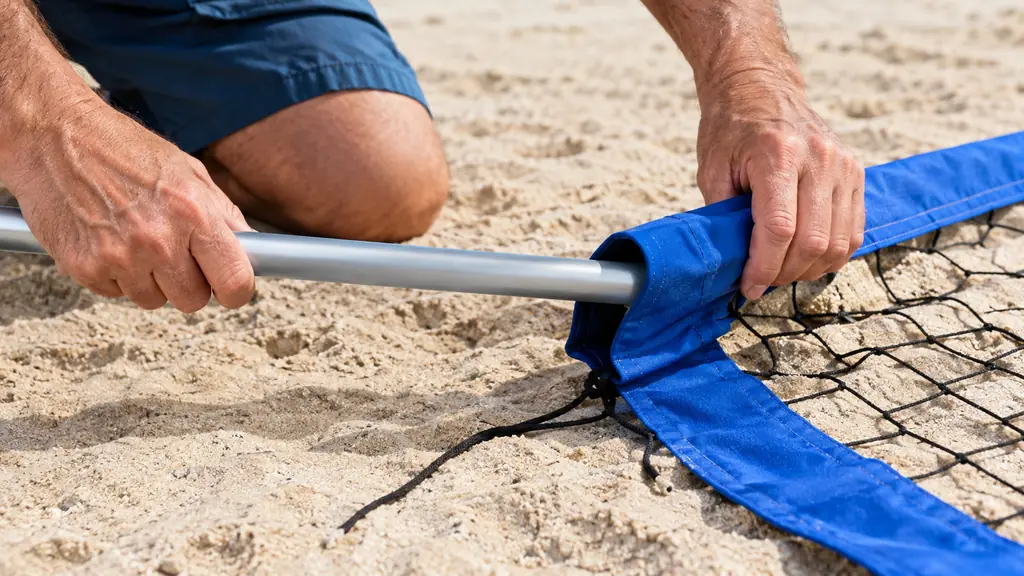
The setup routine became automatic: lay the net out, slide the two poles through the sleeves, push the base into the sand, and crank the winder. The first time took me about fifteen minutes. By the third day I could do it in eight. Taking it down is faster, maybe five minutes, and the whole thing folds into a carry bag that goes over one shoulder.
The grandkids could not set it up on their own. The poles are long and the sleeve fit is snug, which is good for stability and bad for small hands. Walt and I did the setup every time. That is not a dealbreaker, but I want you to know before you buy it for a teenager to manage solo.
Most days we were on the sand by nine, because low tide at our stretch of beach runs mid-morning in July and that is when the sand near the water is at its flattest and firmest. The wagon holds the net bag, two umbrellas, the cooler, and a mesh bag of balls, and by the time Walt has the umbrellas anchored I have the net halfway up. We marked out a rough court about twenty-five feet long, short for real volleyball and perfect for the grandkids and for older knees that do not want to chase a ball into the surf.
The day that stands out was July 12, when Walt's brother and sister-in-law came down with their two kids. Six adults, four kids, one net. The adults played for about an hour while the kids took turns as ball shaggers, and the net took everything we hit at it, including a few serves that would have been out in a real game. Nobody got hurt, and the only argument was about the score, which is exactly what a beach net is for.
What Nobody Tells You Before You Buy It
The listing photos show a perfectly taut net with people diving for the ball. Nobody tells you that the net sags in the middle after about twenty minutes of play, especially in the afternoon when the air warms up. The dip shows up first in the middle of the top edge, where the mesh settles a few inches below where it started. I tried tightening the winder before a game, the way you would tune a guitar string. That helped for the first few points, and then the mesh settled again and I learned to live with a gentle curve in the middle. It is not a broken product. It is physics.
Nobody tells you that the sand stakes are not enough in a real wind. The set comes with stakes that push into the sand, and they work fine for a casual game. But when the afternoon breeze picks up, which it does almost every day at the Jersey Shore, the whole net can tip sideways. I learned to angle the stakes away from the court and to check them between games.
On July 18 the breeze came up around two in the afternoon, the way it does most days, and the net tipped twice in the span of a single game. The first time, Walt reset the stakes at a sharper angle and we kept playing. The second time, the whole thing went over while the ball was in the air, and one of the grandkids nearly landed on the pole. We tried weighting the base with the cooler, which worked until somebody wanted a drink, and then we called it a day. That was the afternoon I learned to read the flags on the lifeguard stand before setting up.
And nobody tells you that the carry bag is the weakest part of the whole kit. The zipper started catching in the first week, usually in the same spot about a third of the way around, and I learned to pull it in two slow passes instead of one. By the end of the month there was a small tear at the seam near the bottom corner, right where the folded poles rest when the bag is over your shoulder. The net and poles are fine. The bag is where Zdgao saved money. If you buy this, plan to replace the bag or treat it gently.
The net and poles are fine. The carry bag is where Zdgao saved money.
What Works Well
The height adjustment is genuinely useful. The poles have a row of holes and a pin, and you can set the net anywhere from badminton height up to full volleyball height. That mattered more than I expected. The grandkids played at a lower height for an hour without getting frustrated, and then Walt and I raised it for a proper game. One afternoon we even played a low-net game with a whiffle ball, and the lowest setting was right for that too. One net, three completely different activities.
The pin and hole system never slipped once, which surprised me. I checked the height before every game and it stayed where I set it, even after a hard hit into the top of the net. The lowest setting is low enough for a small child to reach over, and the highest works for a proper adult game. In between there is a setting that suited the grandkids, one for Walt, and one for the mixed games where the tall adults play against the short ones. That range is the reason this net got used at all.
The carrying bag has shoulder straps, which sounds minor until you are walking a quarter mile across the sand with a cooler in one hand. The whole kit is light enough to carry in one hand and it does not slow you down. I would not want to carry it much farther than that, but for the walk from the cottage to the water it is fine.
The net itself is a decent quality mesh. It took some hard hits from adults and never tore or stretched out of shape. The boundary lines are stitched in, not printed, which means they did not fade after a month of sun and salt water. That impressed me, because I have seen printed lines peel off cheaper nets by the second week. The mesh is also tight enough that a ball does not slide through the gaps the way it does on the string nets at the cookout in our town park.
Where It Falls Short
The tension system is the thing you will notice most. The side winder is a simple crank that tightens a rope along the top edge, and it takes a good minute of turning to go from loose to tight. It works, but it is not precise. There is no ratchet and no click, so you cannot feel where you are, and if you overtighten, the rope digs into the mesh and you have to back it off and start again. On a hot afternoon you will do this between every game. The crank itself is small, about the size of a jar lid, and easy to grip even with sandy hands, so that part they got right. For family play it is fine. For someone who played competitively and expects a crisp, tournament feel, it will frustrate you.
The poles flex. I want to be clear about this because it is the most common complaint in the reviews and I understand why after using it. The first time a hard serve hit the top of the net, the poles bent forward noticeably and the whole top edge went slack for a moment. Walt looked at me and I looked at him, and then the net straightened itself out and we kept playing. It has done that all summer and nothing has broken, but you should know it is coming or you will think you broke it on day one.
The sand stakes are short, about the length of my hand from wrist to fingertip. That is plenty for firm, wet sand near the water. In dry, powdery sand higher up the beach, they pull out easily. I tried stomping them in deeper and they just wiggled loose again. Walt picked up a set of longer stakes at the hardware store in town, and they worked better, but they did not fit in the carry bag, so we only used them on the windy days. I always set up near the waterline at low tide, so the short stakes were rarely an issue for me, but if your beach does not have a wide flat tidal zone, plan to bring longer stakes or a different anchoring system.
What I Liked
- Sets up in about eight minutes once you learn the routine
- Height adjustment covers everything from a child's first game to regulation play
- Light enough to ride in the wagon next to the cooler and umbrellas
- Stitched boundary lines showed no fading after a month of sun and salt
- Low enough cost that it earns its place even if it only comes out a few times a summer
Where It Falls Short
- Poles flex noticeably on hard hits and in a steady breeze
- Sand stakes pull out of dry, powdery sand
- Carry bag zipper catches and the seam tore by the fourth week
- Tension winder is imprecise, no fine adjustment

The Honest Comparison I Keep Coming Back To
The Zdgao is not trying to be a tournament net. It is trying to be the net that makes it into the wagon without a fight and gets the grandkids off their phones for two hours. On that job, it succeeds. The setup is simple, the height range is useful, and it survives a summer of beach use.
My neighbor two houses down has a Franklin, and we traded nets for an afternoon in the middle of July. His net has thicker poles, a ratchet tension system, and a bag with a proper zipper that does not catch. It also takes two people to assemble and it does not fit in a wagon next to the cooler. We played on it for an hour and I will admit the ball came off the net cleaner. Then we put it back in his trunk and set up the Zdgao for the kids. His net is for people who play every week. Mine is for people who play when the mood strikes. That afternoon told me everything I needed to know about which net belongs in which beach bag.
If you play every single day and care about net feel, save up for the heavier net. If you play a few times a month with family, the Zdgao is the smarter buy. I know which one I am, and I know which one is coming back to the beach with me next July.
Who This Is For
Buy the Zdgao if you want a no-fuss net for family beach days, cookouts, or casual games with friends. It is perfect for the grandkids, for adults who just want to bump the ball around, and for anyone who has ever left a heavy tournament net in the garage because it was too much trouble to haul. It sets up fast, adjusts to different heights, and does not cost a fortune. It is also the net I would buy as a first net, the way you buy a first kayak instead of the one you will want in five years.
It is also a good choice if you are not sure how often you will actually use a volleyball net. The price is low enough that it does not feel like a wasted purchase if it only comes out a few times a summer. I would rather own the Zdgao and use it occasionally than own a net that costs several times more and feel guilty every time I leave it at home.
Who Should Skip It
Skip the Zdgao if you play real volleyball and care about net tension. The flex in the poles and the imprecise winder will drive you crazy. You will be happier with a heavier, more expensive net that holds its shape.
Skip it if your beach is consistently windy. The short stakes and lightweight poles mean the net will spend more time on the ground than in the air. And if you plan to carry it long distances, the flimsy bag will probably need replacing before the summer is over.
I kept mine. The Zdgao earned its place in the wagon for another season, and the grandkids are already asking when we are going back. That is the real test, and it passed.
Still deciding? The Zdgao is the net I keep in the wagon
After a full month of beach use, the Zdgao is the net that makes it into the wagon every single time. It is not perfect, but it is honest, and it is priced like it. If that sounds like your kind of beach day, check the current price on Amazon.
Amazon Check Today's Price on Amazon →